Park, S. (2018, August 12). Whitenity, the invention of white Korean. Presented at the 12th Biennial Crossroads in Cultural Studies Conference, Shanghai.
Park, S. (2018, October 9). Whitenity, the invention of white Korean. Presented at the 6th Yun Posun Memorial Symposium, Edinburgh.
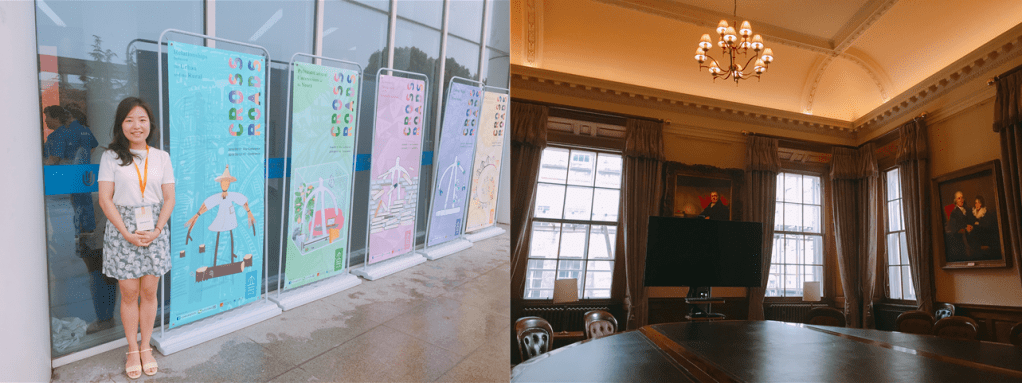
I delivered this presentation in two different international conferences. Crossroads 2018 hosted by Shanghai University was a large international conference for cultural studies scholars. Yun Posun Memorial Symposium hosted by Edinburgh University was an academic gathering for scholars of Korean studies or East Asian studies from around the world.
My presentation included the main arguments and rough plans for my dissertation. I was inspired from the conversations I had with the scholars I met at two conferences, which helped me develop my dissertation.
I used the term ‘whitenity’ which I coined to differentiate it from the whiteness of Caucasians and the Westernized interpretation on the skin-whitening practices of colored people. I am now using the term ‘mibaek(미백/美白) instead, to make the most of Korean/Asian context.
Abstract
This study attempts to discuss the discourse on whiteness in South Korean society, which can be newly termed as ‘whitenity’. There is a strong preference for lighter skin in Korea and whitening lies at the core of Korean beauty products and practices. Furthermore, as so-called K-beauty earns the popularity in Asia, there are a lot of Asians who desire to have ‘white porcelain skin’ of Koreans. Yet, this preference for white skin in Korea and other Asian countries cannot be fully explained through whiteness studies which has developed on the whiteness of Caucasian people. Based on this observation, this paper raises two questions: 1) what constitute whitenity of Korea? 2) What implications does whitenity of Korea have in Asian beauty?
To discuss whitenity of Koreans in Korean context, this research examines the discursive formation of whitenity in terms of the idea, practice, and institution of whitenity. Whitenity can be explored at the multilevel: how it relates to the value of Confucian chastity of women; how it can be differentiated from whiteness in the historical context of Korea; how Korean media technology makes whitening commonplace; how whitening industry has flourished in Korea; how the pageant contest establishes the white skin as the norms of Korean beauty. Thus, whitenity can be defined as discourses surrounding the pursuit and realization of milky white and flawless skin which is distinguished from the whiteness of Caucasian whiteness. And as this idea of whitenity is shared among Asians, it challenges the conventional hierarchy of beauty between Westerns and Asians, or Whites and colored people. The discourse of whitenity establishes the alternative standard of beauty against Western whiteness, shedding new light on Asian beauty, especially the skin of Asians which has been reduced to ‘yellow face.’
 SOJEONG PARK