Hong, S-K., & Park, S. (2022, April 8). Reshaping Hallyu: global reception of Korean content on Netflix. Presented at Is Netflix Riding the Korean Wave or Vice Versa?, Seoul (virtual).
The international conference Is Netflix Riding the Korean Wave or Vice Versa? brought scholars across the continents together to discuss the recent development of the Korean content on Netflix which triggers a fundamental shift in our understanding Hallyu and OTT platforms.
I talked about the transformations in transnational reception of Korean popular culture driven by Netflix based on the research I conducted with Professor Seok-Kyeong Hong and other graduate students in 2020.
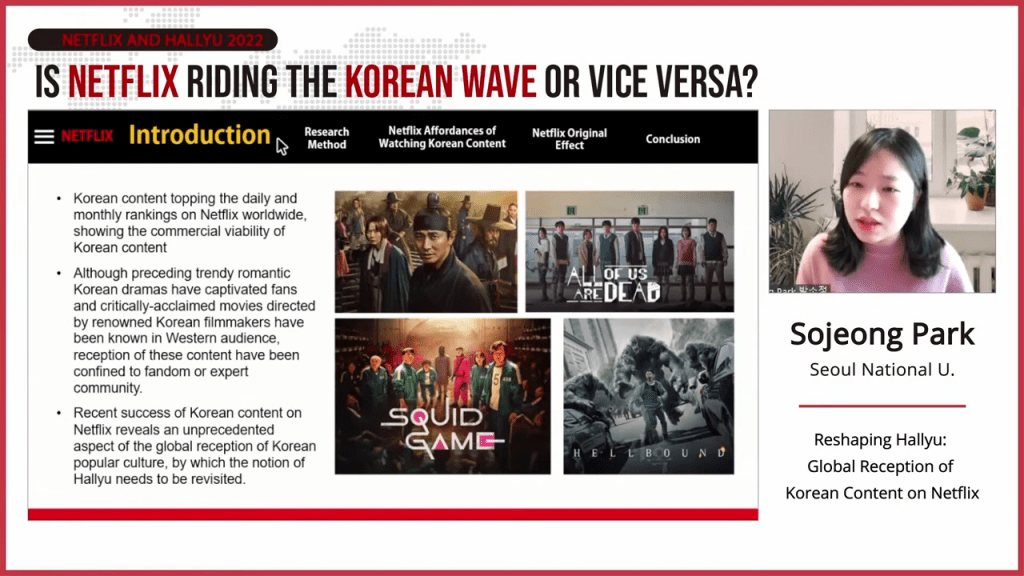
You can watch the entire conference on YouTube: Day 1 (my presentation starting at 1:42:00) / Day 2.
My presentation was featured in The Korea Times.
Extended Abstract
Upon launching the service in Korea in 2016, Netflix actively has serviced Korean content, thus proving Korea to be the content powerhouse of East Asia through Hallyu. After Kingdom, the first Korean Netflix Original series, debuts in 2019, subsequently other series including Squid Game, have topped the daily and monthly rankings on Netflix worldwide, showing the commercial viability of Korean content. The recent success of Korean content on Netflix reveals an unprecedented aspect of the global reception of Korean popular culture, by which the notion of Hallyu needs to be revisited.
This study analyzes how Netflix as an emerging global SVOD service affects the global reception of Korean content, exploring the ways in which Netflix users consume Korean content. The in-depth interviews with 32 viewers of various ages, genders, and nationalities (Japan, US, Brazil, and France) who consume Korean content through Netflix were conducted from July to August 2020. Drawing upon the interview data and the 7 days of media diaries provided by the interviewees, we investigate what technological affordances and content features of Netflix influence the viewing experiences of Korean content consumers, and in the process, compare the experience of the viewers who encountered Korean content for the first time through Netflix and the established Korean content consumers or Hallyu fans who have been enjoying Korean content before subscribing to Netflix.
Netflix’s streaming features such as a content-based recommendation system, archive access, ease of conversing devices, provision of viewing history, and so on serve as technological affordances both for new viewership of Korean content and the established Korean content viewers. Most of the interviewees who first encountered Korean content through Netflix were influenced by the recommender system. Netflix’s content-based filtering algorithms provide users who do not particularly want to watch Korean content with a chance to stumble upon Korean content in various ways. Korean content can appear on their main page after watching a particular content based on similarity of genre or stories, or it can be included in a content list after they searched for a certain title. What is noticeable among this viewership is that they do not necessarily warm up to the recent content. Unlike the viewers who already have much knowledge and experience in consuming Korean content tend to be thirsty for the latest content, those who encounter Korean content for the first time on Netflix watch titles without considering the release years as they lack the background knowledge to discern the latest content and other factors including genre and story matter much more for them. Thus, cases have been observed where the content that aired several years ago in Korea become popular elsewhere years after its release.
On the other hand, to interviewees who had been watching Korean content through other channels, Netflix serves as the optimal channel for experiencing Korean content because Netflix provides them with a viewing experience in which they could enjoy higher-quality Korean content. In particular, many interviewees pointed out that Netflix’s subtitles were a factor that differentiated it from other platforms. The stability of subtitle provision, the reliability of translations provided by professionals, and the consistent translations are all important factors that made these interviewees opt for Netflix to watch Korean content. Also, recommendation algorithms provide established Korean content viewers with the opportunity to experience even a wider variety of Korean content. The interviewees were exposed to Korean titles that they had not seen on other existing platforms through Netflix’s recommender system. These titles had been neglected because they were not exactly the taste of the interviewees. However, as Netflix constantly recommended titles to the interviewees, they started noticing those shows and eventually watched them.
In terms of the content features of Netflix, we pay attention to what we call the ‘Netflix Original effect.’ During the period that we were conducting interviews, Crash Landing on You, Itaewon Class, and It’s Okay to Not Be Okay, were being distributed as Netflix Original series in numerous countries and were gaining global popularity. Most of the interviewees watched or were watching more than one of these Netflix Originals and described them as distinguished content for some reason. For those who are not particularly interested in Korean content, Kingdom and Extracurricular, among others, are first perceived as Netflix Originals rather than as Korean content. As Netflix users equated Netflix Originals with high-quality content, this allows them to choose to watch Korean content. With the trust built upon multiple Netflix Originals experiences, they feel less reluctant to try out the foreign content if it is marked as Netflix Original. Particularly in Japan, which has actively engaged in popular culture exchange with Korea, we could observe many cases where Korean Netflix Originals break the audience’s bias about Korean drama that is based on the experience of the Winter Sonata boom. With the increasing opportunities to be exposed to various genres and narratives of Korean content provided by Netflix, Japanese audiences and journalists even make a distinction between Hallyu drama and Korean drama.
Also, Netflix Originals cater to the young generation with new sensitivity. Itaewon Class, which features diverse characters in terms of race and gender, was mentioned evenly by interviewees from all 4 countries and was praised for showing a new aspect of Korean content. By demonstrating diversity and inclusivity, which are increasingly perceived as important values and ethics, the series was able to appeal to foreign audiences. Besides Itaewon Class, Extracurricular and It’s Okay to Not Be Okay portray a sensitive or dark side of Korean society by featuring characters, topics, and emotions that were not featured in previous Korean content. Viewers who, through previous Korean content, experienced the fantasy world where glamorous characters unfolded their romantic narratives, now experience the aspect of Korea that they’ve always wanted to know about or the harsh reality of Korea through Netflix content.
Overall, based on our findings, we can draw several implications on the change in the global reception of Korean content. While existing Hallyu has been discussed as a celebrity-focused and fandom-based phenomenon, now Korean content are consumed by a broader audience according to one’s taste. Netflix users encounter and enjoy Korean content as one of many high-quality global contents, without necessarily identifying themselves as Hallyu fans. As Netflix plays the role of a cultural mediator based on its recommender system, Korean content is actively consumed transcending the space, time, and genre. Also, the current state that Korean Netflix Originals attract a wider audience by revealing different values compared to previous Korean dramas suggests a direction for future Korean content. The recent Korean titles that have won recognition around the world including Squid Game, mostly illuminate the common malaise of contemporary societies such as inequality, gender conflicts, and racism, Thus, the future Korean content need to orient toward more diversity and sincerity, with the message that can be played out in multiple social contexts and appeal to a global audience.
 SOJEONG PARK