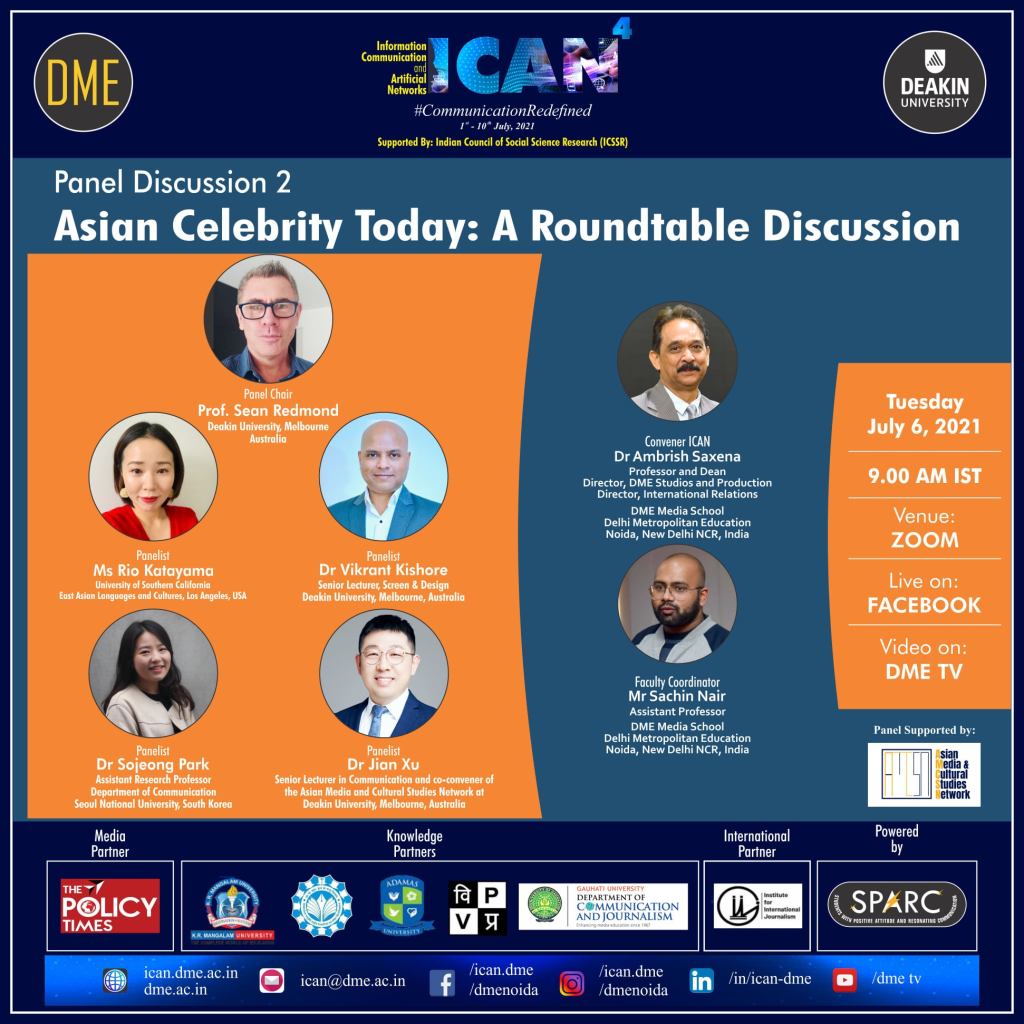
Park, S. (2021, July 6). [Roundtable] Policing ‘K’ in K-pop stardom. ICAN(Information Communication and Artificial Networks) 4. Delhi, India (virtual).
I was invited to ICAN4 as a panelist of the roundtable “Asian Celebrity Today” organized by Sean Redmond in Deakin University. While Each panelist talked about a significant celebrity phenomenon in Korea Japan, India, and China respectively.
I talked about the meaning of ‘K’ works in Korean star and celebrity culture. Cultural content produced in Korea and received by the global audience has been labeled as K-blahblah such as K-pop, K-drama, K-beauty, and so on. However, K does not always stand for ‘Korea’, especially when it comes to K-pop. K-pop industry is targetting the global audience by making the so-called ‘mltinational group(dagukjeok group)’ by incorporating foreign members. And the lyrics, styles, and music of K-pop show a hybridized form of different cultures from different regions. However, the ethnicity of K-pop stars is quite limited. Foreign members of the K-pop group should look like Koreans, or at least be Asians with light skin color. K-pop does not allow racial and ethnic diversity. Thus, the ‘K’ is a sign that raises questions about Koreanness, diversity, colorism, multinationality, and multiculturalism.
 SOJEONG PARK