Kang, M., Lee, J., & Park, S. (2020). Meta-analysis on hate speech studies in South Korea. In M. Kang, M-O Rivé-Lasan, W. Kim, P. Hall, & S. Park (Eds.) Hate Speech in Asia and Europe: Beyond Hate and Fear. Routledge.
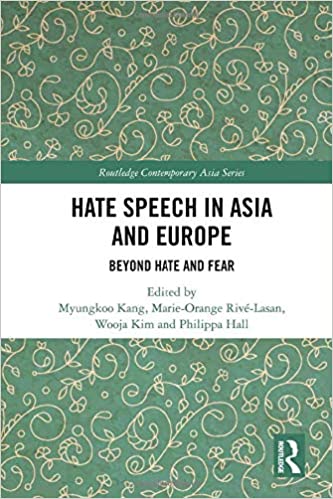
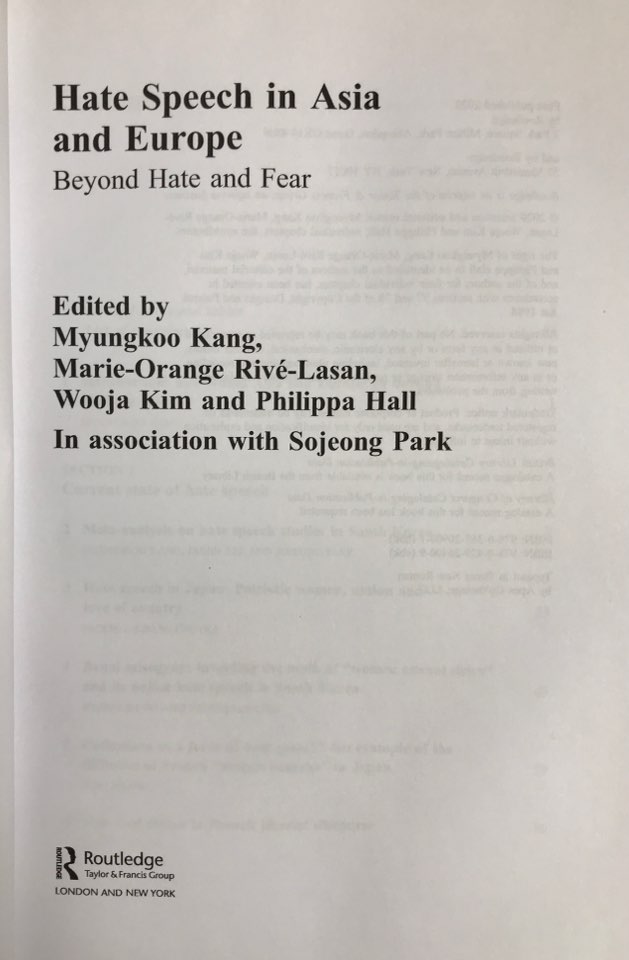
This is an edited collection that provides a timely review of current state of hate speech research in Asia and Europe, through the comparative examples of Korea, Japan, and France. I participated in this publication as a co-author of a chapter and as an associate editor of the volume. You can find more information on this book at here.
This volume was generated out of the international workshop titled “Beyond Hate & Fear: How Do Asia and Europe Deal with Hate Speech?” held at Kyoto in 2018, where I participated as a student member of the organizing committee and presented the paper as well.
The chapter I took part in, “Meta-analysis on hate speech studies in South Korea”, provides a meta-analytical perspective on the past 20 years of research on hate speech in Korea, navigating the landscape of academic discourse on hate speech.
**********
p. 7
In Korea, the main instances of hate speech are hate between social classes, flaming against “Jonbguk (Pro-North Korean forces),” and hate speech directed towards women and sexual minorities, recently made more visible by what is called the “Ilbe phenomenon.”
p. 19-20
Hate speech is the most important of the many social problems that are occurring all over the world, but in Korea it can be expanded to an even more complicated matter as online communication is particularly well developed in Korea. Much of the current research does not seem to provide a consistent answer on how to appropriately respond to this change in social environment. There is no clear definition of hate speech; there are not many studies of hate speech from different academics fields, and there is a difficulty in finding a clear distinction between speech that can and cannot be regulated. Nevertheless, there is a potential and overt harm of hate speech that society will have to address in some manner, and the existing research is significant in that it emphasizes the fact that Korean society must solve this problem in order to realize social justice.
 SOJEONG PARK