Hong, S-K., Park, S., Park, D., & Oh, S. (2019). Geography of Hallyu studies: analysis of academic discourse on Hallyu in international research. Korea Journal, 59(2), 111-143. DOI: 10.25024/kj.2019.59.2.111
This article explores the geography of Hallyu studies published in English. We collected 217 academic articles on Hallyu published in international journals from 2000 to 2016 from the Web of Science, extracted data such as author, journal, and keywords from each article, and structured them into the form of knowledge networks.
You can download the full article at here.
And if you want to see the corresponding work done on Hallyu research published in Korean journals, please see our other article ‘Knowledge network analysis on Hallyu research’.
**********
p. 131
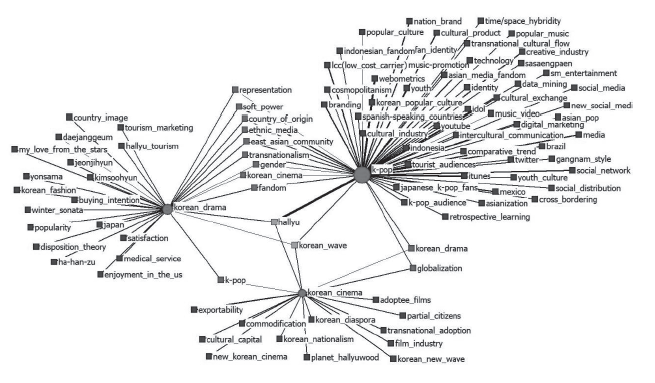
The term “Hallyu” increased between period, while “Korean wave” maintained a similar level. Interestingly, scholars use “Hallyu” more when an article focuses on K-pop, and “Korean wave” when the article is about Korean dramas. Although “Korean wave” is still the more centric word, as seen in Table 2, as academic interest moves from K-drama to K-pop, the term “Hallyu” has become more commonly used.
p. 136
The interest in K-pop has dramatically increased both in Korean academia and international academia. However, international research address “social media” as a keyword much more than Korean research, which shows that international academia is more interested in the media platform through which Hallyu is disseminated. Also, while the attention to Korean dramas has relatively decreased as a research subject in international research, the interest has been continuously maintained in Korean academia. On the contrary, while tourism has had steady popularity as a topic in international Hallyu studies, it has only recently been taken up as a topic of interest in domestic Korean Hallyu studies.

 SOJEONG PARK